On 22 August I was at Cloud Native Summit Kerala — but not as an attendee. We were there as one of the Silver Sponsors, with a small infra0 booth and a table full of stickers. It's a strange shift. At every previous event I'd walked in with a badge, a bag and no obligations. This time I had a booth to run and a product to explain, and I found out fairly quickly that those are two completely different days.
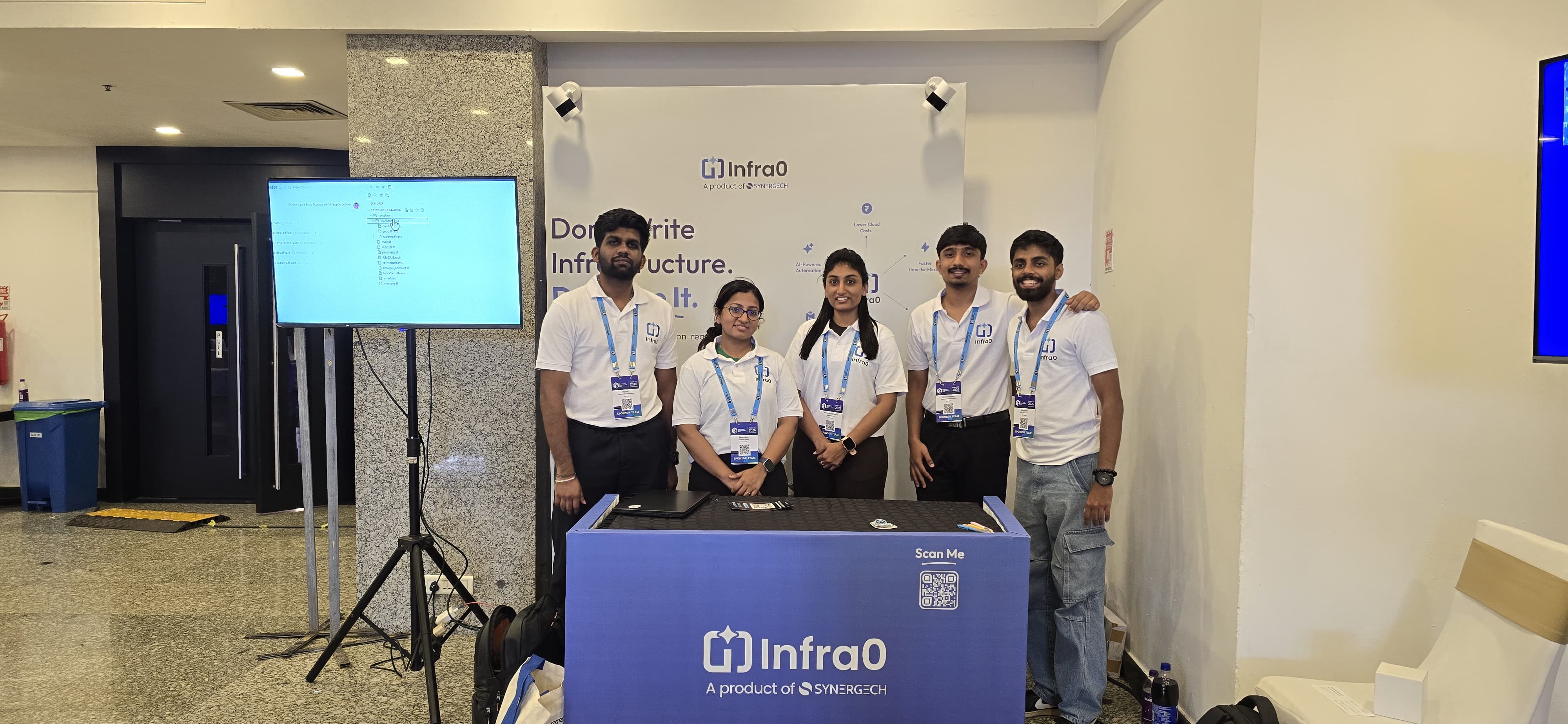
01 — setupSetting up the infra0 booth
Quick context on what we do, and then I'll get out of the way: infra0 turns a natural-language description of the infrastructure you want into OpenTofu/Terraform code you can actually use to provision it. You describe what you need; you get infrastructure-as-code out the other end. That's the pitch, and I promise that's the last time it reads like one.
I was there with four teammates — Rajnish, Shiyam, Swetha and Madhumita. Rajnish and Shiyam handled the technical and product side of conversations, the ones that start with "okay, but what does it generate for a multi-account setup?" Swetha and Madhumita ran lead generation and did most of the work of actually pulling people into a conversation, which is a harder skill than engineers like to admit. By the end of the day I was very glad it wasn't just me and a table.
Registration opened around 7:30 AM. I expected the usual slow trickle where the first hour is sponsors talking to other sponsors. That is not what happened. The turnout was strong almost immediately, and by the time we'd finished laying out the T-shirts and tote bags there were already people walking the floor.
02 — first visitorKrishnan Namboothiri
The very first person to walk up to our booth was Krishnan Namboothiri. He stayed for almost an hour.
Not politely-hovering-for-an-hour. He actually wanted to understand what we were building — how the generation works, where it fits into a real workflow, what happens at the edges. The team went deep with him, and he asked the kind of follow-up questions that tell you someone is genuinely thinking about the problem rather than waiting for a gap to ask for a sticker.
Then he did something I didn't expect. He started bringing other people over. Through the morning he'd walk up with someone in tow and introduce them to what we were doing — effectively giving us a warm handoff we hadn't asked for and couldn't have engineered.
If you've ever run a booth, you know the first hour sets your mood for the whole day. Starting with someone who was interested for real reasons — and who then vouched for us to strangers — meant we hit our stride early instead of grinding our way into it.
03 — the floorThe booth, the conversations, the leads
After that, it didn't really stop.

The mix of people was the best part. Students and folks completely new to cloud and DevOps, who wanted to know what OpenTofu even was. Developers who'd written Terraform under duress and had opinions about it. Senior engineers and architects who went straight for the architectural questions. Security engineers who wanted to know what exactly we generate and how much you should trust it. And enterprise-side technical folks asking the questions that turn into procurement conversations later.
We came away with several enterprise leads, which matters. But the honest highlight was the density of good technical conversation. When an architect pushes back on your generation model, that's free product feedback from exactly the person you need it from.
We ran giveaways all day — infra0 T-shirts, tote bags, laptop stickers, and a raffle roughly every 30 minutes. The stickers were the runaway winner. Not the T-shirts, not the totes. Stickers. I don't fully understand the economics of this community but I've stopped questioning it.
The moment that actually told me how the day had gone came in the evening, when a few people came back to the booth and said:
"We finally got time to talk to you guys because we couldn't get through the crowd earlier."
You can tell yourself the booth was busy. It's different when someone tells you they had to wait out a crowd to reach you — and then came back hours later anyway. That's the metric I'll remember, not the lead count.
04 — full circleMeeting Mumshad
I'd asked Humble, the organizer, in advance if he could introduce me to Mumshad — founder of C1 and KodeKloud. He did.

Some context on why that mattered to me. I found DevOps and cloud through Mumshad's Kubernetes tutorials and courses. That's not a nice thing to say about someone at a conference; it's just what happened. His content is the reason I went down this path at all, and the trajectory of my career changed because of it. I'm currently on track to finish my Kubestronaut, with only the CKS left.
So the line goes: watching his Kubernetes videos as someone with no idea what he was doing → building a career in DevOps and cloud → ending up as product owner of a cloud infrastructure product → standing at a cloud-native conference talking to him about that product. That's a fairly tidy loop, and I'm aware I got to close it in person, which most people don't.
We talked. I gave him an infra0 goody bag, walked him through what we're building, and he was interested in it — asked about it properly rather than nodding through it. I'm not going to inflate this into more than it was: a good conversation with someone whose work I've learned a lot from. But it was easily the part of the day I'd have been most disappointed to miss.
05 — the questionTwo security engineers, and something they both asked
Somewhere in the middle of the day I met Mr. Shine and Mr. Haris, both very experienced security engineers. I ended up in roughly 30-minute conversations with each of them — which, on a booth day, is a small eternity.
We covered cloud security, engineering, the work they've done across their careers, my own path into this, and what I'm building now. These were the conversations where I stopped being in booth mode and was just talking shop with people who knew considerably more than me about their corner of it.
One detail I still find funny: both of them use keypad phones. Not smartphones. And neither was especially interested in giving out an email address. Two senior security engineers at a cloud-native conference, deliberately running a minimal personal attack surface. I didn't press for the reasoning. I just enjoyed it.
But the thing that stayed with me was a question they both asked — independently, without having spoken to each other:
"Why weren't you speaking at the event?"
I gave some version of "we're here as a sponsor this time" and moved on. Except it kept happening. Through the day, other engineers and attendees asked variations of the same thing — was I giving a talk, was there a session, was I running a breakout. Enough times that it stopped registering as a compliment and started registering as feedback.
06 — buildersMeeting the Dr. Droid team
I also got to meet my contemporaries from Dr. Droid, who had their own booth. We traded notes — how their tool works, what they're building toward, what we're doing with infra0. They were interested in what we're building, and I came away with a much clearer picture of theirs.
There's something quietly good about two teams solving adjacent problems spending twenty minutes comparing approaches instead of circling each other. Getting to see what other people are actually shipping is one of the underrated reasons to be at these things.
07 — organizersA huge shoutout to Humble
We were one of the last sponsors to register. Genuinely late. Humble welcomed us anyway and helped us get set up without once making it feel like we'd created a problem for him — which, logistically, we probably had.
The event itself ran well. Registration started on time, attendance was strong, the speaker lineup was solid, and the whole day moved smoothly. For us, the most valuable part was how technical the audience was. Nearly everyone who walked up to our booth could meaningfully evaluate what we're building. If you're a sponsor, that's the whole game — a hundred relevant conversations beat a thousand badge scans.
And more than the logistics, the event created a room where sponsors, engineers, developers, security folks and cloud-native practitioners actually talked to each other. That doesn't happen automatically. Someone has to build it deliberately.
08 — the shiftWhat being a sponsor taught me
I've attended AWS Summit before, as a regular attendee. I thought that meant I knew what conference days felt like. It doesn't.
As an attendee, your day is yours. You listen to talks, meet a few people, walk the floor, learn from speakers, leave when you're done. It's an intake exercise.
As a sponsor, you're on the other side of the transaction. You represent something you built. You explain it forty times, and you get better at it around explanation twelve. You listen to people's actual problems instead of a speaker's framing of them. You get feedback instantly and in person — including the face someone makes when a feature doesn't land, which no survey will ever capture. You start to see who your real customers might be. You learn what resonates, and what you should stop saying.
The most valuable thing we got wasn't the lead count or the visitor count. It was the quality of the conversations — and hearing, repeatedly and unprompted, which parts of what we're building people actually cared about.
I understand our own product better after one day of explaining it to strangers than after several weeks of talking about it internally. That's not a knock on the internal work. It's just that a room full of skeptical engineers is a very efficient testing environment.
09 — closeThe question I'm taking home
Which brings me back to Mr. Shine and Mr. Haris, and everyone else who asked the same thing.

I've spent years building things, breaking things, working with cloud infrastructure, DevOps, Kubernetes and security, and lately representing a product technically. Somewhere in there I defaulted to the assumption that I'm the person behind the booth, not the person on the stage. Nobody told me that. I just decided it.
When enough people who have no reason to flatter you ask why you weren't speaking, the sensible response is to stop deflecting and consider that they might be seeing something you haven't.
So that's what I'm taking home from Cloud Native Summit Kerala. Not the leads, not the sticker economics, not even the full-circle moment — although I'll take that one too. Just a question I didn't arrive with:
Maybe I should be on the other side of the booth next time. On the stage.
Next Cloud Native Summit Kerala, I'd like this not to be my first experience as a sponsor. I'd like it to be my first as a speaker.
10 — thanksThank you
To Mr. Srini, my CEO, and Mr. Venkatesh, our Finance Head — thank you for backing this. Sponsoring an event on short notice requires someone to say yes quickly, and you did.
To Rajnish, Shiyam, Swetha and Madhumita — you ran that booth for a full day without losing energy, and the reason people kept coming back is that you were good to talk to. I was lucky not to be doing this alone.
To Humble — thank you for taking on a late sponsor without hesitation, for the introduction to Mumshad, and for running a genuinely well-executed event.
To Krishnan — thank you for being our first visitor, for giving us a real hour of your time, and for bringing people over all morning. You set the tone for our entire day, and I don't think you were even trying to.
And to everyone who stopped by the infra0 booth — including the people who came back in the evening because they couldn't get through earlier. That's the part I'll remember.
—
questions about infra0, or want to talk cloud-native? email me or find me on linkedin.