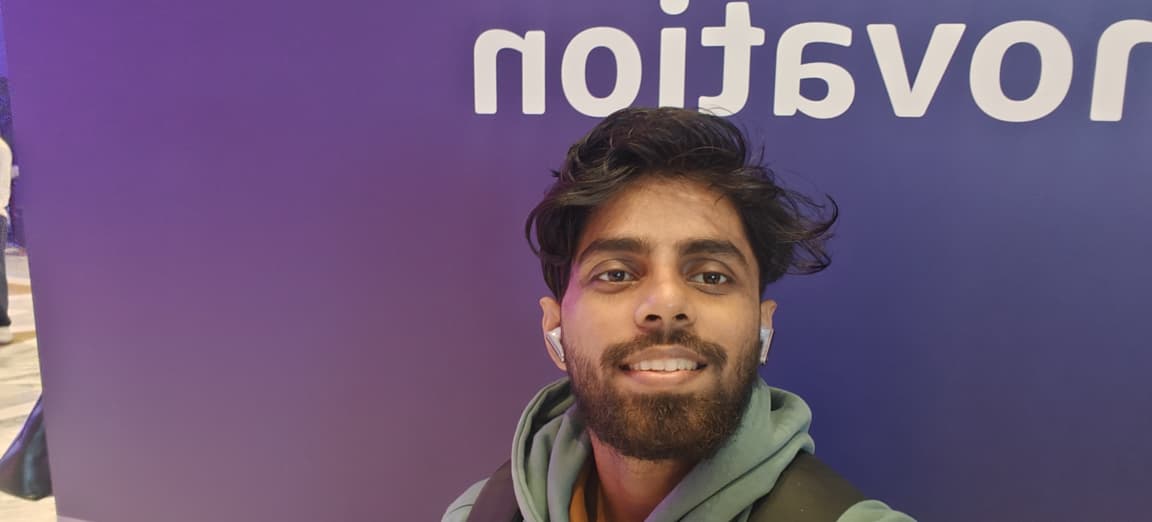
I was the only person from Synergech at AWS Summit Mumbai this year. That's not a complaint — it meant I could move fast, skip the talks that didn't apply, and spend actual time on the floor talking to people. Here's what I came back with.
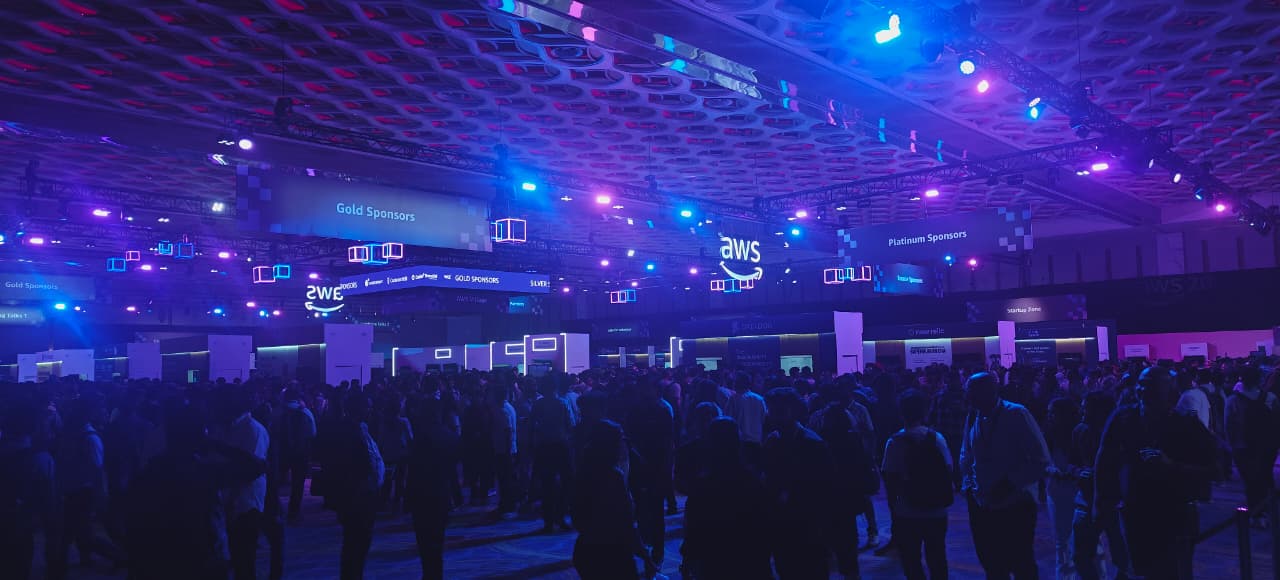
01 — the floorThe scale of the thing
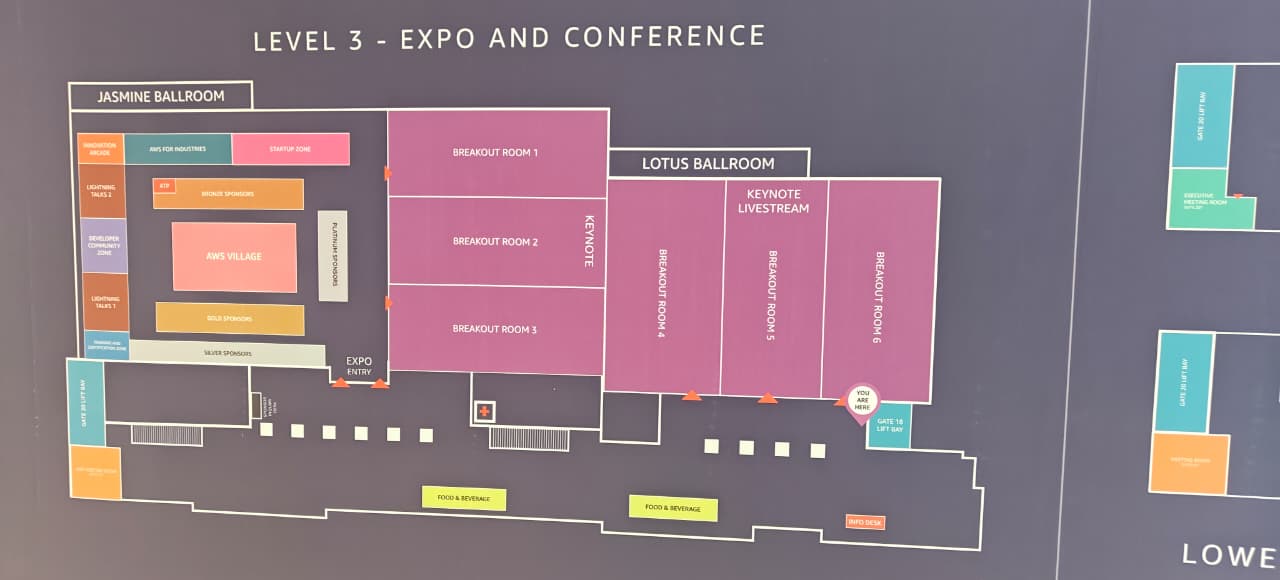
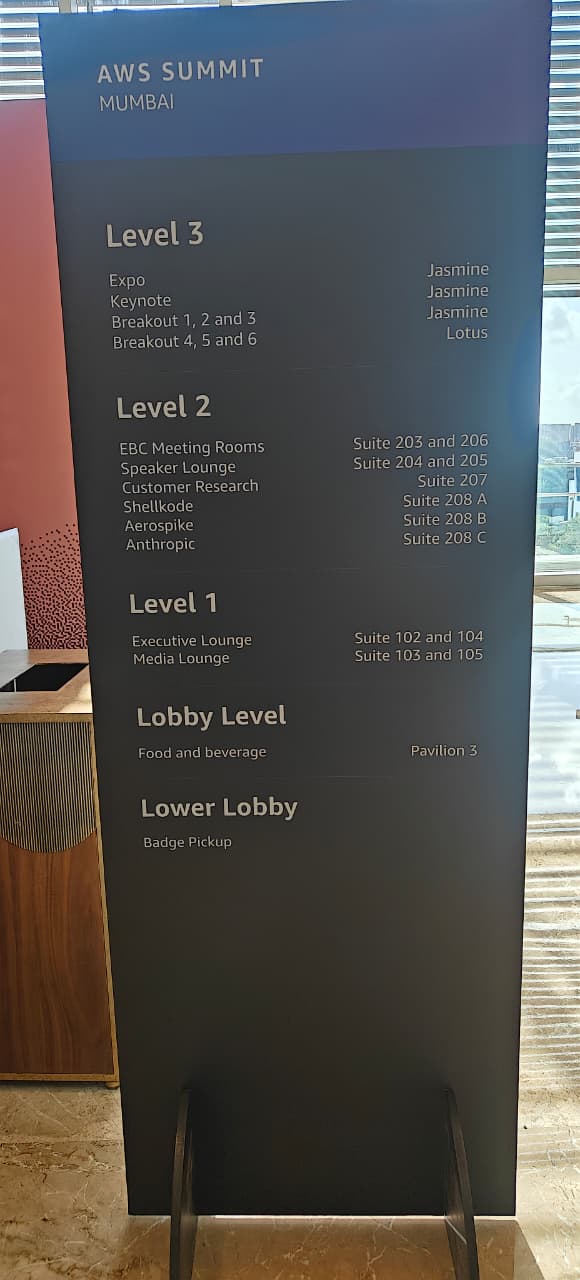
Mumbai was big. Bigger than I expected. The venue spanned three levels — the keynote and all six breakout rooms on Level 3 (split across Jasmine and Lotus Ballrooms), Anthropic's dedicated suite on Level 2 alongside Aerospike and Shellkode, and badge pickup in the lower lobby. The floor plan alone was worth a photo.
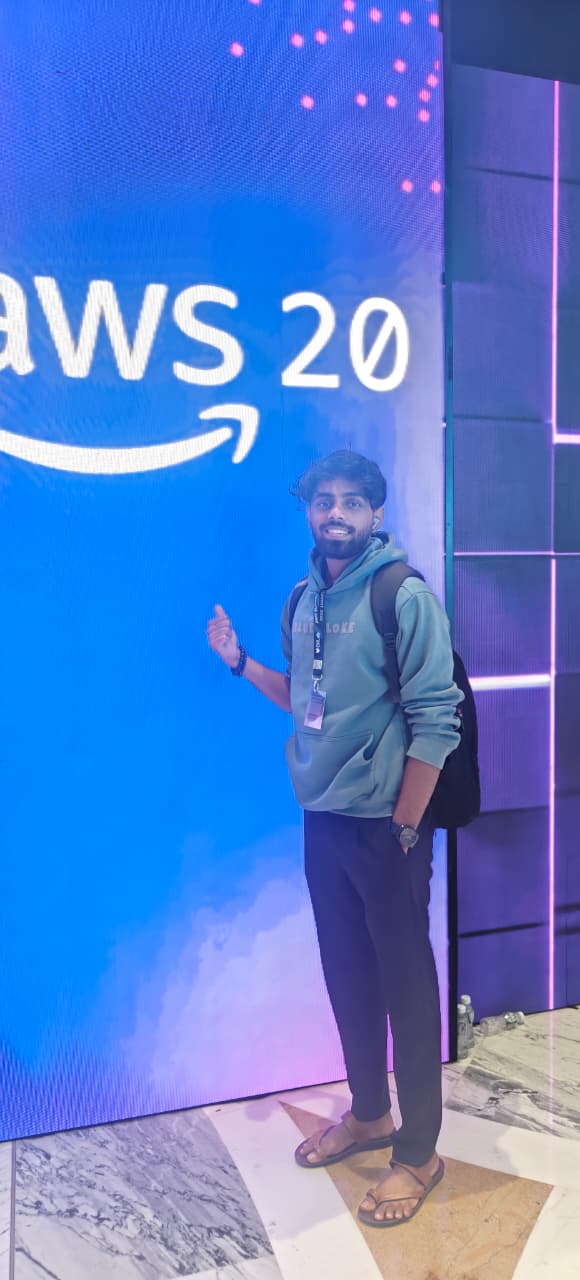
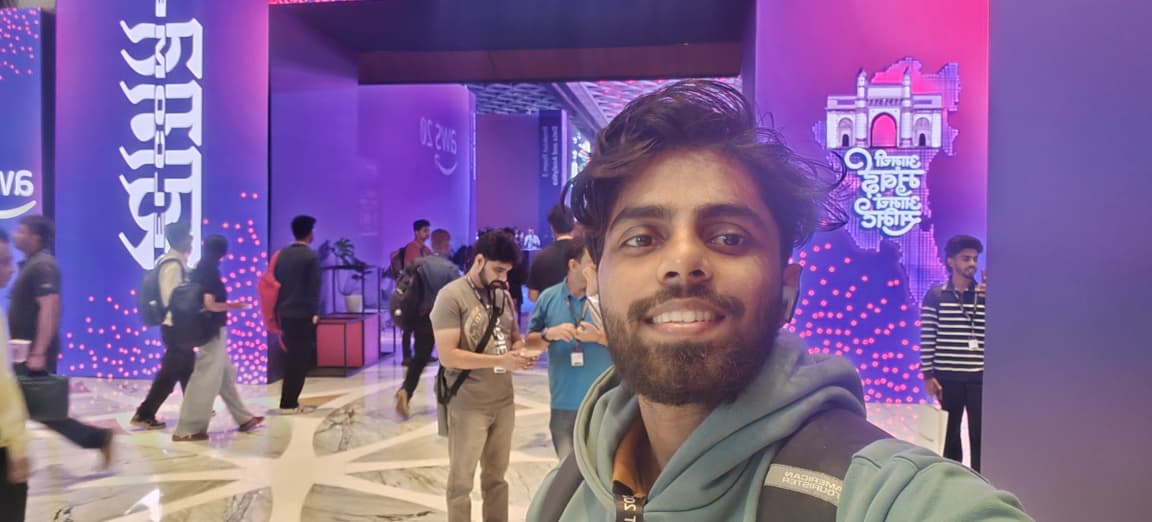
The exhibition floor was a mix of AWS service booths, consulting partners, and a surprisingly large cluster of AI-native database startups — the kind that have built their entire pitch around microsecond and millisecond latency for AI logs and aggregations. That cluster was the most interesting part of the floor walk.
Most of them are solving a real problem: as inference workloads get chattier, the observability layer becomes a bottleneck. They want to sit between your AI runtime and your data warehouse and eat the hot path. Whether any of them survive to Series B is another question, but the problem is genuinely unsolved at scale today.
02 — anthropicTen minutes with the Applied AI Head
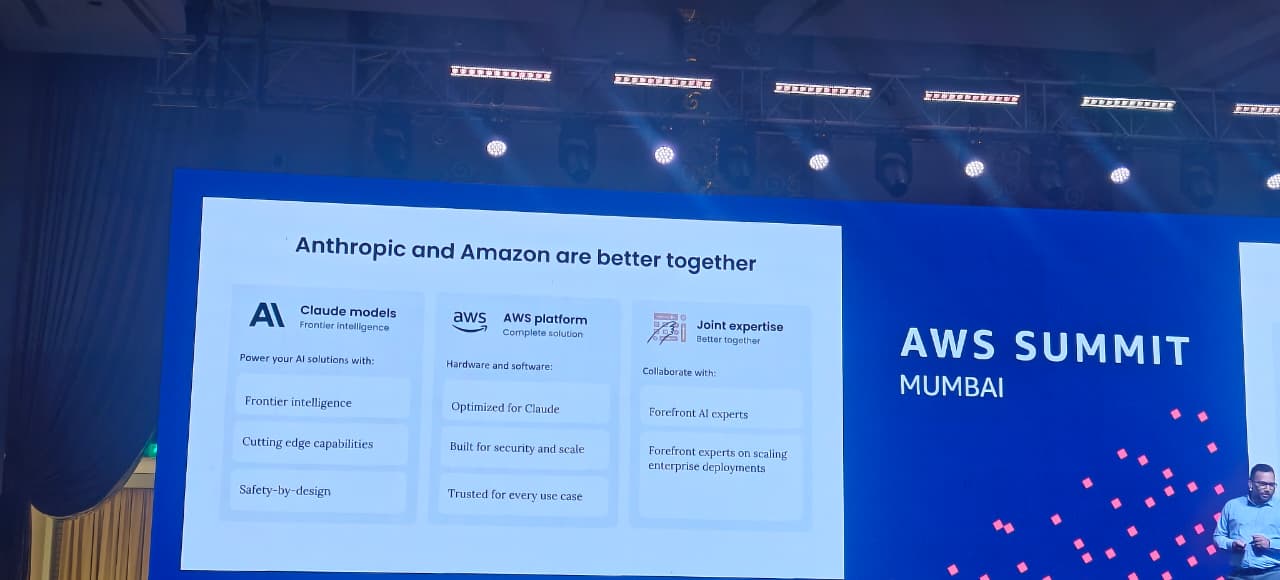
Rishikesh Radhakrishnan, Anthropic's Head of Applied AI, presented at the event. After his session — which was anchored around the Anthropic + Amazon partnership and practical agentic patterns — I got about ten minutes with him.
I came in with questions on input caching and KV caching — specifically around cache invalidation behaviour at the token boundary and how the routing layer decides what to evict under memory pressure. These are the questions that come up when you're actually running production inference workloads and the cache hit rate matters for both cost and latency.
His answer was honest: too technical to discuss publicly, and IP-constrained in a way that means nobody at Anthropic will be able to answer those questions externally regardless of context. He said I was on the right track — which is either genuinely encouraging or the most polite way to close a line of questioning. I'm choosing to take it at face value.
The most useful conversations at conferences aren't the ones where you get answers. They're the ones where you find out which questions are worth asking.
03 — securityAgent security and shifting left
The other conversation that genuinely moved my thinking was with Saurav Chakraborty, Cyber Security Lead and Head at Nykka. We got into agent security — specifically, what a shift-left security posture looks like when the "code" running in production is an LLM completing a prompt.
The traditional shift-left story is: catch vulnerabilities in the dev cycle before they reach production. For agents, that model breaks down. The attack surface isn't static code — it's the runtime behaviour of a model responding to user intent. You can't lint your way to a secure agent.
What Saurav was pushing on — and I think he's right — is that agent security requires intent monitoring: logging not just what the user typed, but what the model inferred the user wanted to do, and whether that intent falls within policy. It's a different kind of audit trail from what most security teams are used to building.
- Monitor prompt intent at the system level, not just prompt content
- Treat tool calls as privileged operations — every invocation should be auditable
- Shift left by embedding security evaluation into the agent design phase, not post-deployment
- Define and enforce intent boundaries before writing a single agent prompt
This maps directly to work we're doing at Synergech. The InfraGenie agents have tool access — provisioning, config changes, state reads. That access is privilege. We haven't been treating it that way consistently. This conversation changed that.
04 — sessionsThe two breakout sessions
I attended two breakout sessions. Both were worth the time.
Agentic AI on AWS
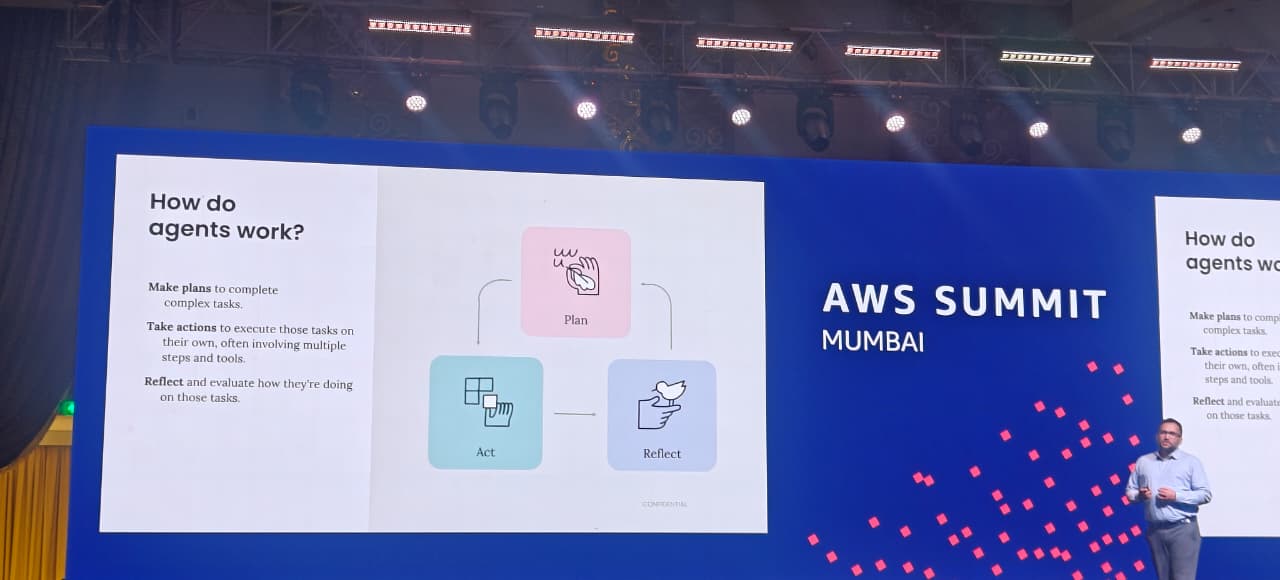
The first walked through the full agentic stack — from how agents work at the model level, through multi-agent architectures, to the design components that make or break production deployments. The Plan → Act → Reflect loop was presented as the foundational agent pattern, which is accurate for most of the agent systems I've seen in the wild.
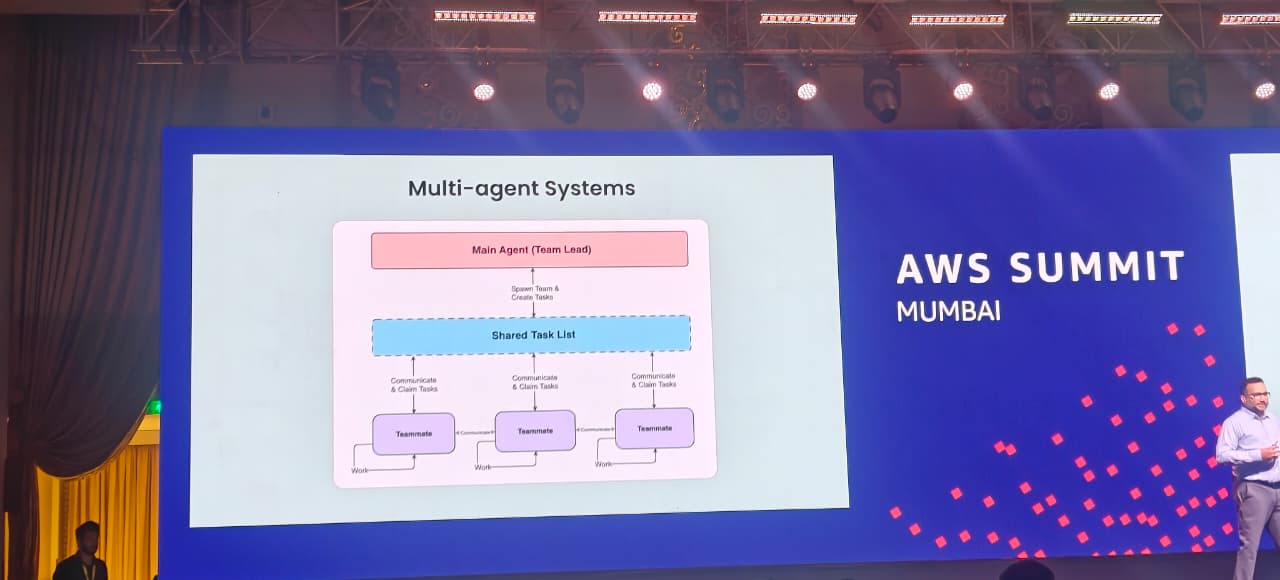
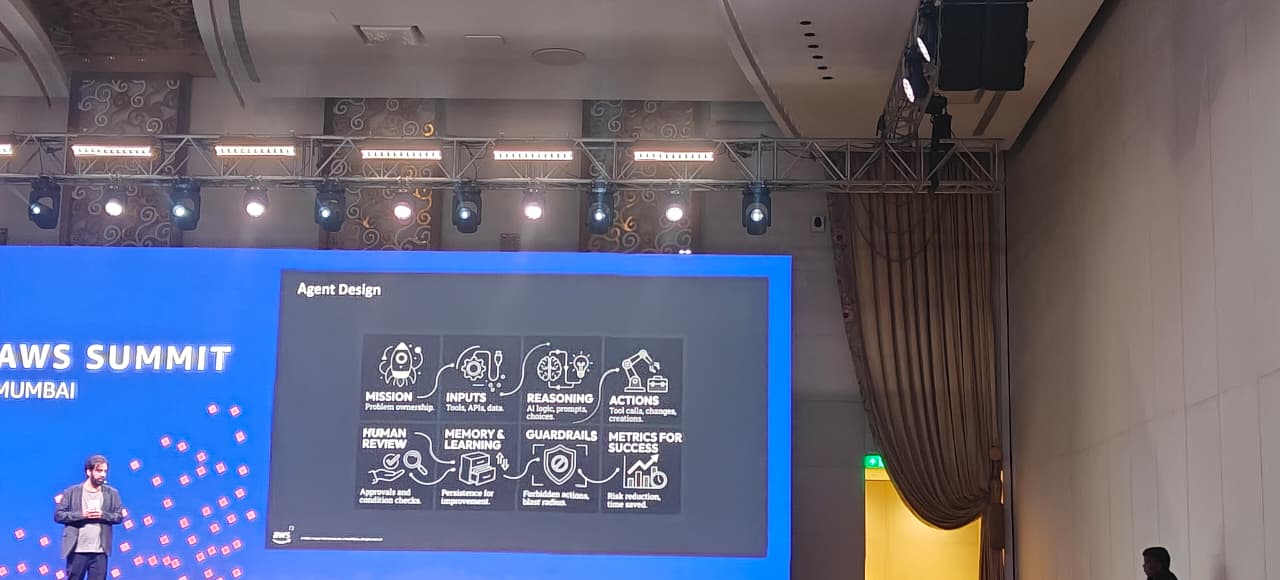
The multi-agent architecture slide was a good reminder of what the real engineering challenge is: not building one good agent, but building a coordination layer where a team lead agent can spawn, assign, and track teammates against a shared task list without the whole thing turning into a coherence problem.
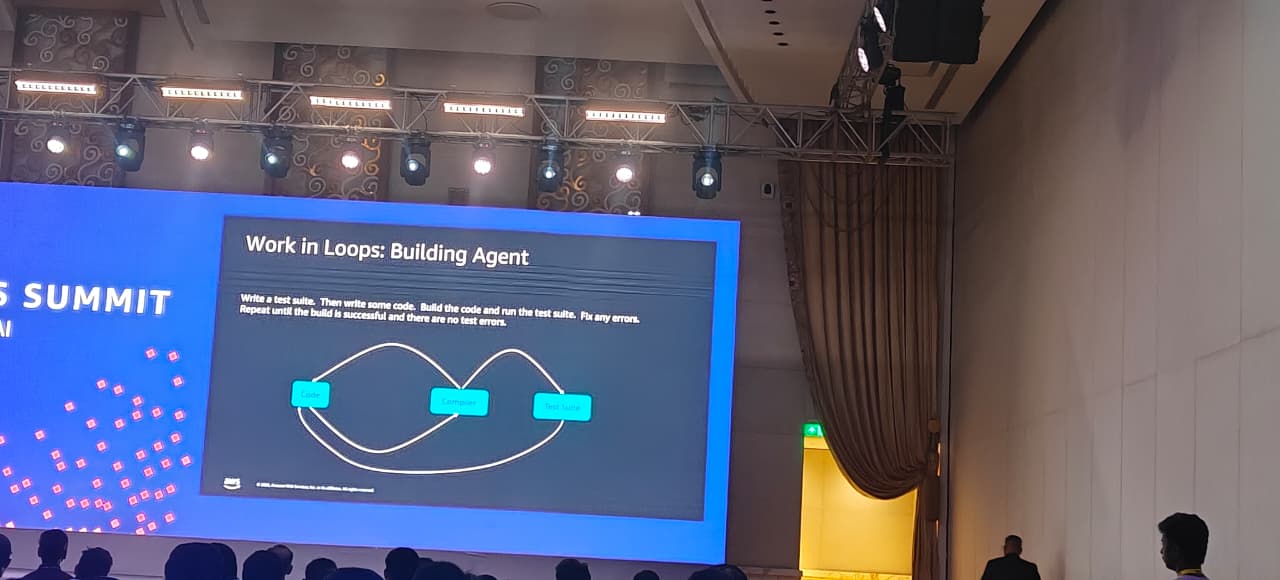
The "Work in Loops" pattern for building agents — write tests, write code, compile, validate, repeat until green — also came up. It's obvious in retrospect but most teams I've seen skip the test-first step entirely.
Security for AI at scale
The second session was anchored around Nykaa's security posture — 52M+ customers, 150M+ monthly visits, 350+ services, 2.25 billion API interactions per day. The scale makes the problem concrete in a way that abstract threat models don't.
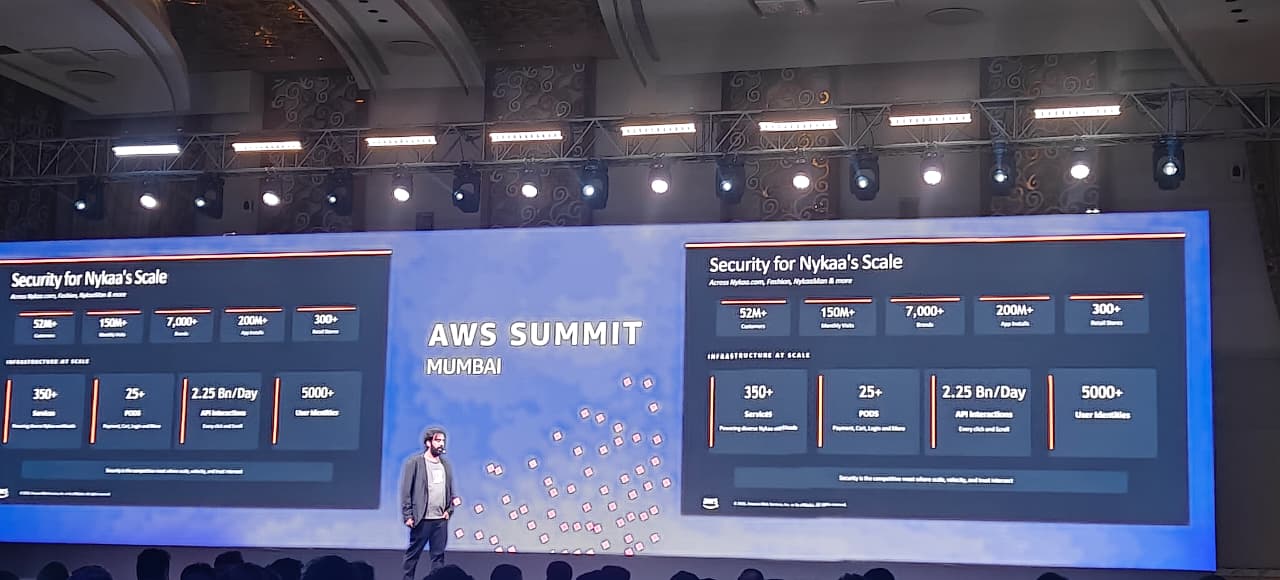
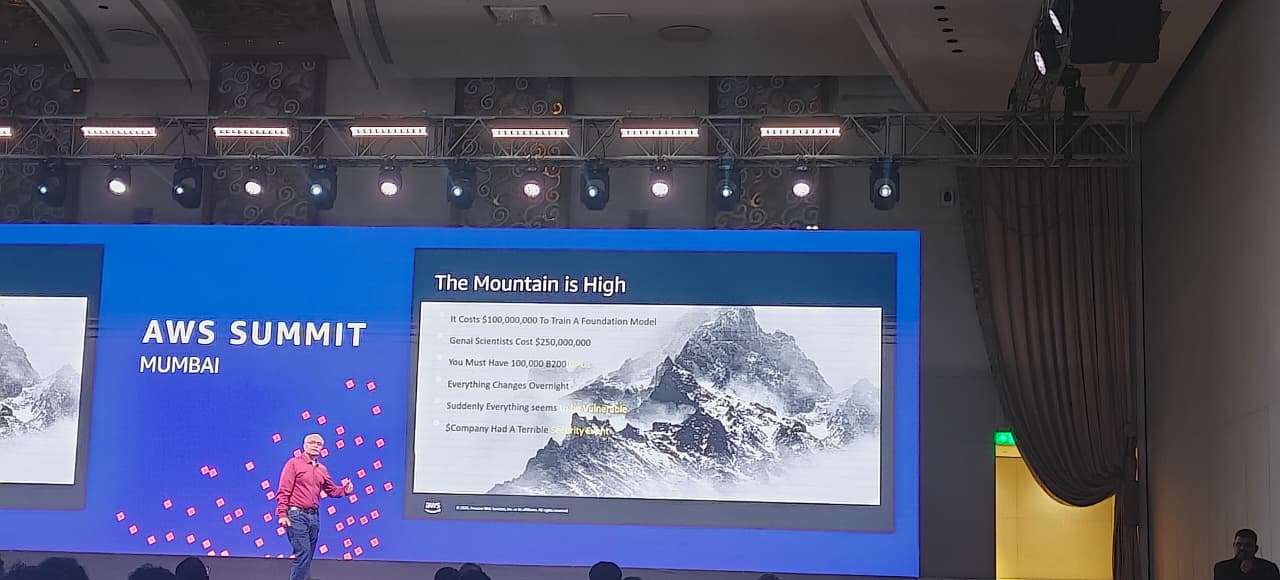
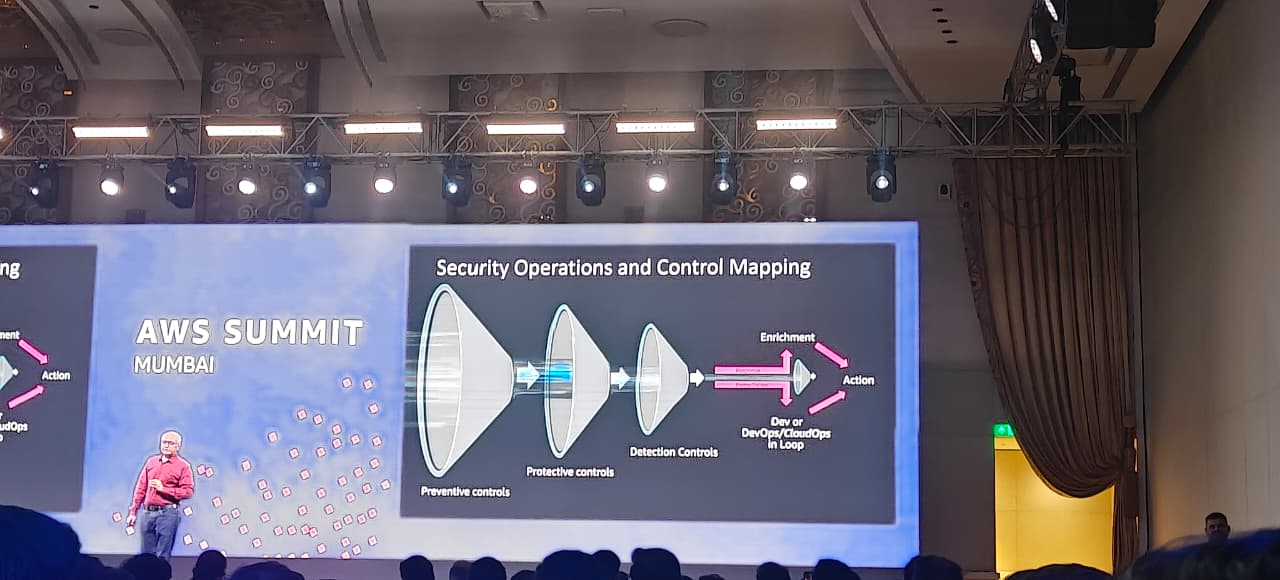
The core argument from that session: the next evolutionary phase of security isn't just more tooling, it's a fundamentally different operating model. The Security Operations and Control Mapping framework they presented — preventive controls → protective controls → detection → enrichment → action — is the kind of layered model that holds up when you actually stress-test it against AI-specific threat vectors.
05 — from the floorVideo from the day
Four clips from around the venue — the expo floor, sessions in progress, and the general scale of the thing.
06 — closeWould I go again?
Yes. Without hesitation.
The format works better when you're solo. You make decisions faster, you end up in conversations you wouldn't have prioritised with a colleague in tow, and you're more likely to approach someone you don't know. The floor time was more valuable than most of the structured sessions — which is usually how it goes.
The things I'm bringing back: a clearer mental model for what questions about caching internals to drive our own experiments, a concrete framework for agent security that I'm applying to InfraGenie, and a watchlist of two AI database startups whose architectures are worth following.
Next AWS Summit: I'd push to bring at least one more person from Synergech. Not because I needed backup this time, but because this kind of event is most useful when the team density goes from one to two.